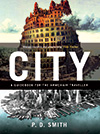
City: A Guidebook for the Urban Age
Today, for the first time in history more than half the population of the planet live in cities. Two hundred years ago, just three per cent were city dwellers, but by 2050, 75 per cent will be urbanites. My new book City is a guidebook to our urban age, taking the reader on a journey through the past, present and future of the world’s cities.

The experience of living in cities is universal. As one historian has written: ‘A town is always a town, wherever it is located, in time as well as space.’ The first cities were built in the fertile land between the rivers of the Tigris and the Euphrates in the south of Mesopotamia, part of modern Iraq.
When the first city builders set out on their urban experiment thousands of years ago, they created far more than a new man-made environment built of mud bricks. From them emerged the building blocks of civilisation, including essential skills such as writing and mathematics.
City dwellers created a new way of being. Humanity was reinvented in these pioneering cities. Urban communities formed a revolutionary social and moral order that broke free from the rigid structures – tribes and clans – of the rural world. According to a medieval German saying, ‘Stadtluft macht frei’, city air sets you free. You can be whatever you want to be in a city.
Above all, what motivated me to write City was a desire to explore and celebrate what is undoubtedly humankind’s greatest achievement. They are complex and increasingly sophisticated technological environments that (pace Winston Churchill) shape us as we shape them.
When you have spent all your life in cities, it is easy to forget the exhilarating sense of awe felt by those who encounter the city for the first time. The German poet Heinrich Heine experienced this in 1827: ‘I have seen the greatest wonder which the world can show to the astonished spirit; I have seen it, and am more astonished than ever – and still there remains fixed in my memory that stone forest of houses, and amid them the rushing stream of faces, of living human faces, with all their motley passions, all their terrible impulses of love, of hunger, and of hate – I am speaking of London.’
Heine’s words speak powerfully of the potentiality and sheer concentrated energy of the city: intense, overwhelming, exciting, chaotic, and sometimes more than a little scary.
Poets like Heine make the world anew through their work, so that we see it as if for the first time. They make the stone stony, in Viktor Shklovsky’s memorable phrase. I hope my book will reawaken in you, the reader, something of the sense of wonder that Heine felt on seeing London for the first time.

Iain Sinclair is right when he says that ‘walking is the best way to explore and exploit the city’. To really understand a city, you need to walk its streets, reading its geography and history through the soles of your feet. My book is designed with this in mind, as a guidebook to an imaginary ‘Everycity’. It will accompany you on your way around those many features of urban life and geography that have been present in cities since the beginning and have become part of our urban genetic code.
City is divided into eight sections – Arrival, History, Customs, Where To Stay, Getting Around, Money, Time Out, and Beyond the City. Each section contains between three and five essays. In Customs, for example, you will find essays on writing, street language, graffiti, demonstrations and carnivals. Each of these also contains a mini essay exploring one aspect in more detail, such as the momentous events in Tahrir Square, which is part of the essay on demonstrations.
After each section there is a longer essay on a more concrete feature of the urban landscape, typically a structure or space common to most, if not all, cities. They explore the Central Station, the City Wall, the House of God, the Hotel, the Skyscraper, the Department Store, the Park, and the Ruins. All the essays are illustrated.
If you want, you can start on page one and read all the way through to the end. But I have tried to create a book in which you can wander and drift. The elements of surprise and discovery are important, just as they are when you explore a real city. Open the book anywhere and begin – there are no set routes.
From the Central Station you could strike out to Chinatown or the House of God. Then you could grab some Street Food to eat in the Park before making your way to the Department Store. In the evening you could explore the City and the Stage, or stroll through the Red-Light District, and then head back to your Hotel or Downtown apartment for the night. As in a real city, you can follow any number of pathways through the book. And don’t worry about getting lost. Some say it’s the only way really to experience a city.

A book such as City takes quite a while to write. (I’ve been working on it since 2007.) It’s a rich field for research and new material is appearing practically every day as cities evolve and grow. While writing City I came across many fascinating topics, quotations and images that could have been included in the book. In an alternative, Borgesian universe, City might morph into a neverending encyclopaedia of urban wonders. But in what we choose to call the real world, I limited the book to 120,000 or so words.
I’m always interested in news about cities. If you have something to share, Twitter is a good way to get in touch. I use the hashtag ♯cities for urban topics.
If you want to read some of my reviews and articles on urban themes you can find them by clicking here.
You can find photos of some of my favourite cities on my Flickr page.
City was published by Bloomsbury on 24 May 2012 in the UK and on 19 June in the US. I hope you like it. You can read an edited extract from the essay on urban infrastructure, “The Wired City”, on the website of the Australian Design Review.
The audiobook is available from Audible in the UK and the US.
In 2014, Colin Marshall interviewed me for his excellent series of podcasts, Notebook on Cities and Culture. We talked for about an hour about our experiences of cities and about my writing. You can download the podcast from his website. I also had a wide-ranging discussion with Rob Ferrett at Wisconsin Public Radio about cities and you can download the programme (about an hour long) here.
You can read the following interviews with me about cities and my book -
Stimulus Respond (Omen issue)
Future Cities: PD Smith & Darran Anderson in Conversation
What people are saying about City
“…thank you for inspiring me to try harder to inspire my kids.”
— Neville Gibbs, Waitakere College
“The author’s ideas are original and inventive enough to warrant his description of the book as ‘a guidebook to an imaginary Everycity.’ It’s a great thinker whose musings run the gamut from the Aztec capital of Tenochtitlan to Tahrir Square, graffiti to gladiators, who can quote the Old Testament and Baudelaire, and throw in an infographic entitled, ‘When skyscrapers rise, do markets fall?’”
— Allison Arieff, “Reading the City”, New York Times, 17 December 2012
“A magnificent achievement.”
— Mark Lamster, Design Observer, 3 July 2012
“The city is a big subject but this is readable, concise and extremely entertaining. Smith spans the emergence of the first Middle Eastern cities – places with no streets, so inhabitants needed to walk on roofs and descend ladders to reach their homes – up to informal settlements and high-tech hubs today. Well-researched, well-written and clear.”
— Edwin Heathcote, Best Books of 2012, Financial Times, 30 November 2012
“For every urban coffee table.”
—Metro, 16 May 2012
“The book…is a rich kaleidoscope celebrating urban life in all its aspects… Smith’s approach is to take the reader on a series of tours, which are consistently well-written and researched — and impressively eclectic — that reveal his subject matter in myriad small glimpses… Smith’s book is at once a hugely enjoyable read and an inspiring vision to aim for.”
— James Mather, Spectator, 7 July 2012 (PDF here)
“It’s a remarkable book. Enjoyable and enlightening, City is easy to read but also encyclopaedic in its multi-dimensional journey through urban life.”
— Julian Woodford, HistoryLondon, 13 January 2013
“It is a love song to cities, large and small.”
— Tish Wells, Kansas City Star / McClatchy Newspapers, 6 June 2012
“Smith packs the blood, guts, underbelly and driving forces of the archetypal city into chapters as densely packed as the streetscapes of Manhattan or Hong Kong. […] The sorcery of cities should not be lost; Smith’s ebullient guidebook helps to remind us why.”
— Jonathan Glancey, Guardian, 9 June 2012
“an excellent introduction to the city, and should be on every student’s reading list”.
— Richard Cole, Urban Design, issue 126 (Spring 2013), 56–7
“[T]he book’s hodgepodge structure excitingly mirrors the improvised order of cities themselves, and Smith encourages his readers to ‘wander and drift,’ a strategy liable to generate surprising juxtapositions – as between urban birds, which sing at a higher pitch than birds in the country, and the police drones that fly above the streets of Liverpool.”
— The New Yorker, 6 August 2012, p 73
“[O]ne of the best books on the city yet…”
— Bosco K. Ho, Boscoh.com
“A one-volume overview of a potentially daunting subject, made readable, and even gripping, through fine writing and magazine-like sidebars… Effortlessly flitting from the surprisingly modern grid plans of ancient Chinese cities to the hauntingly timeless-looking ruins of contemporary Detroit, City represents a pain-free – in fact, joyful – survey course on nine millennia (at least) of urban history.”
— Taras Grescoe, Globe and Mail, 30 November 2012
“City is one of the best books we have laid eyes on this year.”
— Easy Voyage, May
“Half a century ago, Lewis Mumford published The City in History, a hugely influential and in some ways controversial book that has been the Bible for students and lovers of city life… A new look at this great subject has for some time been needed, and in City: A Guidebook for the Urban Age, P.D. Smith provides it. A British scholar connected to University College London, Smith is less philosophical and more empirical than Mumford, but if anything this is welcome, as City is wholly accessible to the serious general reader. […] If there’s anything of consequence about cities that Smith fails to discuss or at least mention, I don’t know what it is.”
— Jonathan Yardley, Washington Post, 8 June 2012
“Highly recommended for anybody who can appreciate cities as more than just the place they commute to.”
— Michael Gross, Prose and Passion
“Reading it is like being seated next to the most-informed, and most charming guest at your dream dinner party, someone with an endless font of facts enlivened by quirky and often hilarious anecdotes.”
— Mark Lamster, Notable Books of 2012, Designers & Books
“Mr Smith has written an unapologetic paean, not to any particular city but to the urban idea in general…The result is a sort of high-quality, unusually rigorous coffee-table book, designed to be dipped into rather than read from beginning to end…an excellent introduction to a vast subject”.
— The Economist, 28 July 2012
“Migration, food security, global tourism, natural disasters, economic expansion, and war: these are all perennial influences on urban form—and urban futures—and Smith works hard to show their role in shaping the life of what he calls ‘the ape that shapes [its] environment, the city builders.’ ”
— Geoff Manaugh, BLDGBLOG, 1 June 2012
“It’s a wonderful book: BLDGBLOG meets Italo Calvino. Gorgeous, smart, fun, and full of surprises, like wandering all the world’s great cities at once … Irresistible”
— David Dobbs, Wired.com
“A compendious and lavishly illustrated guide to real cities and the ideas they embody”.
— Brian Dillon, Irish Times, 14 July 2012
“The overall effect is an energetic tribute to the city rather than a guide or academic study — a celebration of city-ness itself. Smith…writes plainly and with astonishing scope, persistently global and seemingly at home with everything from Mardok to Masdar. The little thematic essays are a joy… With even littler texts boxed in colour and scattered hither and yon, City is a tremendously jazzy, restless book.”
— Will Wiles, Icon 111 (September 2012), 87
“From megalopolis to small urban spaces, we cannot deny that the power and influence of cities is truly global, as Smith argues. This book is a perfect way to understand the globalised phenomena hidden behind the word ‘city’.”
— Ethel Baraona Pohl, Domus, 29 June 2012
“I love it… a selection of insanely fascinating sections about cities and how they came to be what they are, what they are and may become, the forces at play inside them and how those forces show themselves in architecture and society. In many ways the perfect brainfood for a writer, and a book you can dip into and immediately get lost in.”
— Nick Harkaway, Goodreads, April 2012
“…handsome and well-written…the great strength of City is that it gathers in one place myriad themes and angles, providing generalists with a highly readable, pithy resumé of centuries of city-related happenings and trends. Authors such as Alain de Botton and Iain Sinclair have covered similar territory elsewhere, but Smith is less pretentious and and less opaque than either…”
— Chris Moss, Times Literary Supplement, 15 June 2012
“Witty, eloquent and tellingly concise”
— Annick Labeca, Urban Lab Global Cities, 18 September 2012
“Smith deftly integrates the narratives of far-flung places across centuries. Discussing sports within city bounds, he draws a connection between the Roman Colosseum and skateboarders in Venice Beach. In this continuum, he creates an uber-city, a grand portrait of what urbanity is and might become.”
— Carolyn Kellogg, Los Angeles Times, 9 December 2012
“The range of material is breathtaking, but Smith wears his erudition lightly. The prose of City is smart and fast-paced, with a nice balance between big picture history and close-up details. The book is full of “aha” moments and occasional humor. This one’s a must read for history geeks.”
— Pamela Toler, Shelf Awareness, 29 June 2012. Starred review.
“Like any great city, this is a book to get lost in, to try out new areas, to sample to savor, to enjoy…VERDICT: A wonderful and revealing look at cities in all their glory from viewpoints throughout history. Highly recommended for readers across many subject categories, including urban studies, cultural history, and travel.”
— Library Journal, 137, no 6 (1 April 2012): 86–87. Starred review.
“The pleasure in reading City comes from moving quickly from subject to subject, skipping one moment from a paragraph on urban cemeteries to another on graffiti, and linking a chapter on hotels to another one on coffee shops…If you have ever loved a city and felt that you belong downtown somewhere, whether in the hot, fragrant roads of Bangkok or the buzzing streets of New York, there’s something in PD Smith’s City for you…[A] fun, optimistic read that is also highly informative and one that I’ll return to as both a reference and for the pleasure of its photographs and curious anecdotes.”
— Elizabeth Whitmore Funk, Bookbrowse.com
“Hugely enjoyed @PD_Smith’s City, a deep and authoritative anatomisation of the place where most of us now live.”
— Paul McAuley on Twitter
“[A]n impressively comprehensive look at this very broad topic…the kind of book that will be of interest both to the general reader and the avowed urbanist.”
— Nate Berg, Atlantic Cities, 22 June 2012
“Smith’s prose is clear-cut and confident, and the book features stunning illustrations, most of them in colour…Smith is especially adept at capturing the incessant human interaction which characterizes city life, from carnivals to street demonstrations and graffiti. Readers can virtually smell the pho sold by a street vendor in Hanoi, or marvel at acrobatics of skateboarders along the Thames. An absorbing and timely book.”
— Marc Vincent, Cleveland Plain Dealer, 24 June 2012
“A thorough and often engaging account of urban life, from the Uruk in Sumer and the Aztec capitol Tenochitlán to Tokyo, currently the planet’s largest burg with 35 million people”.
— David Holahan, Christian Science Monitor, 12 July 2012
“Smith composes a polyphonic paean to our urban past, present and future… As exciting, sprawling and multifarious as a shining city on a hill.”
— Kirkus Reviews, 15 March 2012. Starred review. Eric Liebetrau, editor of Kirkus Reviews, also included City among his Best Nonfiction of 2012.
“Whether evoking the slums of Mumbai, a 1905 dinner party at London’s Savoy Hotel, or the Aztec capital of Tenochtitlán before Cortés conquered it in 1521, Smith proves a lively, learned narrator with a strong synthetic sense. Discursive, imaginative, and comprehensive, his analysis of everything from the Hanging Gardens of Babylon to skateboarding and graffiti should be savored. Read in parts or whole, readers can wander and drift, and enjoy the element of surprise, just as in the exploration of a real city.”
— Publishers Weekly, 13 February 2012. Starred review.
Buy at Amazon.co.uk | Amazon.com | Barnes & Noble | Bloomsbury | Indiebound US | Waterstones | Guardian | Audible UK | Audible US | IndieBound UK